
President’s Message
In my last newsletter message, I explored workload problems arising from management consultant reviews of universities. In this message, I continue the exploration by looking at a specific type of consultant recommendation to improve efficiency and save money: the centralized service hub.
The time to think about the workload implications of centralized service hubs is now, and not just because Deloitte is on campus. Over the next two to three years, Trent plans to introduce a tiered student service model designed to streamline student access to help. My understanding is that this will involve a centralized service hub designed to manage most student inquiries and direct students to appropriate services. Other universities, like the University of Alberta and the University of Sydney, introduced centralized service hubs for both academic staff and students. So, it is possible that a centralized service hub for faculty and librarians may also follow at Trent.
What are centralized service hubs, exactly? Centralized service hubs funnel communication through a single portal, direct inquiries to specific units, and use a ticketing system to keep track of inquiries. I’m not an expert on hubs, but I believe they resemble our IT ticketing system and Emburse’s centralization of reimbursement. The difference is that they capture most of the services that students or staff need to access for assistance.
Creating a hub system typically requires reorganizing staff and modifying their job descriptions to fit the new system. For example, a university might move most advising formerly undertaken across campus by faculty, college heads, academic advisors, enrolment staff, etc., to one centralized advising unit.
On the one hand, it is often good to improve efficiency and reduce costs, provided that doing so preserves functionality and the raison d’être of a place. While I was reviewing degrees at another university several years ago, the dean described the institution as a big ship accruing ever more bureaucratic barnacles. I feel this way about Trent sometimes, and most universities are like this. Barnacle management might increase the boat’s velocity made good.
On the other hand, there are over 2000 barnacle species and centralized service hubs might increase our exposure to new ones. Other universities implementing centralized systems have experienced significant problems. There are cautionary tales from the corporate sector as well. Centralized service hubs may:
- create barriers to communication
- reduce flexibility in response to changing environments (I believe this is a key issue with centralized service hubs in the corporate world.)
- decrease information sharing between units and between individuals
- increase administrative complexity
- generate routing failures (inquires go to the wrong place)
- increase error rates
- increase wait-times for responses
- require back-up systems in case of system failure (hence, further complexity and costs)
- require time-consuming, expensive integration with existing units, a process requiring specialized expertise
- erode domain specific knowledge held by non-academic staff and create knowledge gaps
- alienate students and staff
In responding to these problems, workloads increase for non-academic staff. Chairs and program directors reading this already know this means even more work for them. And it means more work for faculty and librarians in their teaching, research, and service. Further, there may also be financial costs such as reduced student retention and lower productivity generally. And this places additional pressure on faculty.
UBC, likely aware of these issues, appears to have opted for a federated system that mixes centralization and decentralization. I haven’t done a formal comparison, but this may be something like what we have now at Trent. To be clear, I don’t know what kind of centralization Trent is moving towards, or what the student service hub will be like. Maybe it will be great. But Trent runs so lean already that I worry centralized service hubs will make things less efficient via new barnacle accretion. Further, I worry that to reduce costs associated with implementation and software, Trent might reduce non-academic staffing further. If so, people in our community will lose good jobs and the cuts will further erode the domain-specific knowledge we need to make this place run. Even if no staffing cuts follow, we may still find ourselves trapped in hub-created imbroglios.
The upshot: We stand at the threshold of potentially worsening administrative health at Ontario Universities and further erosion of education and research.
So, please share your views with the provincial government, at Senate, and with the employer and other Trent forums for discussion and change. Everyone at Trent wants things to run smoothly and well, and we are all subject to the pressures of underfunding. Let’s be proactive, ask lots of questions, and challenge as needed.
I leave off with a Nous consulting firm-inspired flowchart, intended (I assume) to help University of Alberta’s faculty, staff, and students understand their centralized service hub. I have read unconfirmed reports that the University of Alberta paid Nous $6.5 million for their services. Worth thinking about as you try to make operational sense of the chart.
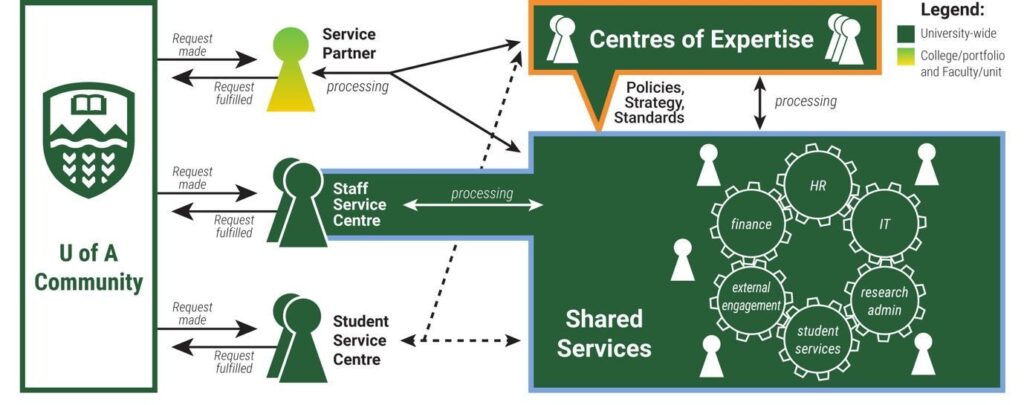
See also: https://thegatewayonline.ca/2023/01/two-years-in-review-academic-restructuring-at-the-u-of-a/
Reminder: Your action is needed. Please write to the provincial government to express your views on Senate governance, which is now at risk. On August 5, TUFA circulated an email from OCUFA regarding a provincial government survey on governance. The survey itself disappeared without explanation, but you can still email your comments. For additional background, please see TUFA’s August 5th email (subject line: provincial governance survey), and our August 9th email, which notes the government’s survey problem and provides the email address. If you wish, you can draw text from these emails for your own email.
From the Table
As you will recall from our last newsletter, negotiations began June 24th with the Bargaining Team exchanging proposals with the Employer and attending a series of meetings with senior administrators. For today, we thought an update on the University’s strategic planning and review from the Ministry of Colleges, Universities, Research Excellence and Security would be most valuable to relay to the membership (see below).
Bargaining will resume the week of August 25th.
The University is working on Strategic Planning: What It Means for Faculty
To address the financial challenges posed by constrained Provincial funding and the federal government’s constriction of international student enrollments, the University has launched three working groups: the Enrolment Task Force, which is focusing on recruitment, retention, and conversion strategies; the Cost Containment & Reduction Working Group, which is exploring departmental budget cuts and operational savings; and the Revenue Generating Working Group, which is looking at ideas like new summer programming, executive education, and international initiatives. These groups are currently preparing reports for the President, supported by feedback gathered through a campus-wide survey on creative cost-saving and revenue strategies.
At the same time, Trent learned that the Ministry of Colleges, Universities, Research Excellence and Security expects the University to undergo an Efficiency and Accountability Review. Deloitte has been hired to carry out this review, with a preliminary report due by October 1, followed by a final implementation plan in December. The review covers governance and administration, academic programs, physical assets and facilities, procurement practices, and revenue generation strategies. The Ministry is requiring that Deloitte also examine the Senate’s role in decision-making, review low-enrolment or low-labour-market-demand programs, explore administrative and HR efficiencies, and consider the sale of surplus assets or use of reserves. The University expects the review will actually confirm that many efficiencies have already been implemented and provide evidence to advocate for changes in tuition policy and funding from the province.
For members, the financial plans for 2025–26 included a net reduction of 12 full-time equivalent positions, mainly through non-renewal of limited-term appointments (LTAs). However, the impact of this on the membership has been mitigated by retirements, deferred hires from prior years, and the replacement of some LTA lines with tenure-track positions. . The TUFA office is still receiving confirmation of new hires and renewals, but it would appear that the net impact of this year’s reductions on the bargaining unit will be minimal with a net loss of 3-5 TUFA positions. Salaries are budgeted to increase in line with contractual agreements, although broader cost-cutting pressures remain. While no program closures or pauses are currently proposed, the government-mandated review process requires the University to consider program viability based on enrolment and labour market demand, which could have future implications. The role of Senate and the Board of Governors is also under review, raising concerns about potential changes to shared governance and academic decision-making.
In terms of bargaining, the administration has indicated that their priorities are to protect student experience, academic quality, and minimize harm to people and culture. Yet there are real concerns for our members: increased workload as programs consolidate or administrative support shrinks, potential erosion of shared governance if Senate’s role is weakened, long-term job security issues and the sustainability of smaller programs. While the provincial government clearly views retrenchment as desirable, the continued underfunding of the sector pose real challenges. How far can we really go in the name of efficiency before it undermines the very things that make the University successful? From TUFA’s perspective, there is an undeniable tension between improving operational efficiency and protecting the core mission of teaching, research, and community engagement. There are limits to what can be cut before the student experience and faculty’s ability to deliver it truly suffer. At the same time, the EAF process could help illustrate to the government the relative efficiency of Trent and just how much Trent’s faculty already accomplish with limited resources, reinforcing University’s case for sustainable funding from the Ministry.
Ultimately, while University leaders describe this review as an opportunity to tell Trent’s story, it’s clear that the coming months will require careful advocacy, collective vigilance, and member solidarity as we navigate bargaining and long-term institutional change. Efficiency has its costs – our relative efficiency, is in part a reflection of a very high student to faculty ratio at the University — and TUFA’s bargaining team will certainly be mindful to protect the membership against further impositions as the University works to comply with the Ministry’s directives.
Trent
Major Federal Investment in Canadian Research
In July, the Government of Canada announced more than $1.3 billion in funding to support over 9,700 researchers and research projects nationwide. This significant investment underscores a national commitment to strengthening Canada’s innovation capacity, supporting public health, addressing climate change, and advancing social equity.
The funding, announced on July 9, 2025 by the Honourable Mélanie Joly (Minister of Industry) and the Honourable Marjorie Michel (Minister of Health), will flow through the country’s three federal granting councils, CIHR, NSERC, and SSHRC and includes:
- $365.6 million in scholarships and fellowships to 4,761 recipients
$589 million through the NSERC Discovery Research Program to 2,950 researchers - Over $127 million in SSHRC Insight Grants and an additional $55 million in Insight Development Grants
- Support through programs such as the New Frontiers in Research Fund (NFRF), Partnership Grants, Vanier Canada Graduate Scholarships, and Banting Postdoctoral Fellowships
Our People in the News
Examining the Realities of China’s Arctic Investments – Insights from Dr. P. Whitney Lackenbauer
Research co-authored by Dr. P. Whitney Lackenbauer of Trent University sheds new light on China’s presence in the Arctic, challenging widely held assumptions. The paper, Cutting Through Narratives on Chinese Arctic Investments, published by Harvard Kennedy School’s Belfer Center, finds that China’s Arctic activities are often overstated. Of 57 identified projects, only 18 remain active today, with just one located in Canada. The majority have been cancelled or remain uncertain.
Dr. Lackenbauer, who holds the Canada Research Chair (Tier 1) in the Study of the Canadian North, recently appeared on TVO’s The Agenda with Steve Paikin to discuss broader issues of Arctic security, sovereignty, and governance. Known for his extensive scholarship, including award-winning books like Arctic Front: Defending Canada in the Far North, Dr. Lackenbauer continues to provide invaluable insights into how Canada can responsibly manage and protect its northern interests.
Watch the full TVO interview here: Shoring Up Canada’s Arctic Sovereignty
Trent Researcher Co-Leads $2.5M SSHRC Project on Climate Storytelling
Trent University’s Dr. Neil Ever Osborne is co-leading a new $2.5M SSHRC-funded project, From Catastrophe to Community: A People’s History of Climate Change, which will train students and journalists to document the lived experiences of 1,000 climate change survivors worldwide. The project aims to reshape climate communication through trauma-informed storytelling, with outputs including documentaries, an anthology, and a travelling museum exhibition.
Building on the work of the Climate Disaster Project, the initiative brings together collaborators from universities and cultural institutions across Canada and beyond. With Trent playing a key leadership role, the project also supports the university’s new Climate Communication Option, helping to train a new generation of storytellers to centre resilience, justice, and lived experience in environmental discourse.
Highlighting Advocacy: Aaron Shafer Champions Fair Access for Palestinian Graduate Students
Dr. Aaron Shafer, Chair of Trent’s Forensic Science Department, and member of TUFA’s Scholar and Student at Risk Committee has been at the forefront of a national movement to raise awareness about the unjust and prolonged visa delays faced by Palestinian students accepted into graduate programs across Canada. Through his work with the organization PSSAR (Professors & Staff for Palestinian Academic Rights), Aaron has emerged as a leading advocate on this issue, bringing faculty voices into the national conversation on academic freedom, mobility, and equity.
Aaron’s advocacy has garnered widespread media attention, helping to elevate the voices of affected students and call attention to the systemic challenges they face navigating Canada’s immigration system. A major concern is the year-long (or longer) delays in visa processing, delays cited by Immigration, Refugees and Citizenship Canada (IRCC) as bureaucratic or security-related, yet which other countries have found ways to expedite.
On July 9, Aaron appeared on CBC’s Ontario Morning, offering a powerful and incisive account of the obstacles these students face, and calling for a compassionate, coordinated response from Canadian institutions and policymakers. This follows a growing series of national news stories that have covered the issue, featuring Aaron’s commentary and leadership.
This media coverage not only underscores the urgency of the situation but also reflects the public value of faculty advocacy. Aaron’s efforts exemplify the kind of engaged, outward-facing work that strengthens Trent’s academic values and the Union’s commitment to social justice.
Remember When
When we come together, we strengthen our sense of solidarity and build a united front. We can’t wait to see everyone at our next social, which we’re planning for this fall, stay tuned for details!


Member Updates
Share Your News & Events
While not officially endorsed by TUFA, this section is here to help share your events, updates, and initiatives with fellow members. Have something coming up? Hosting a survey? Want to spread the word? Send the details to [email protected] to be included in an upcoming newsletter.